
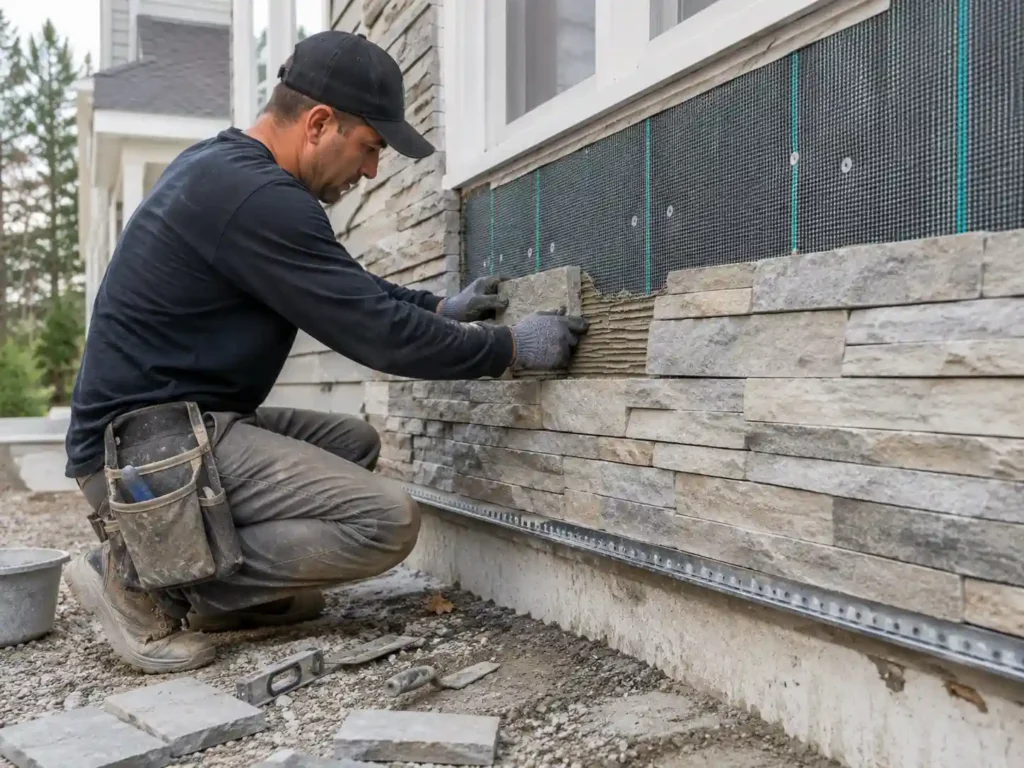
Adhered stone veneer looks like full masonry at a fraction of the weight and cost. Picking the stone is the fun part of the project, and it is not what determines whether the wall lasts.
What matters is the assembly behind it. Home inspectors who specialize in this cladding report finding the same defects on house after house: no weep screed, no kickout flashing, no drainage path. Those houses look fine from the street and rot from the inside. Our stone work sits under stone facades and masonry.
Tell Us More About Your Project
Send us a message and someone from our team will get back to you as soon as possible! For faster response, please call (201) 750-3590
This surprises homeowners, so it’s worth saying plainly. Adhered veneer is not a waterproof layer. Water gets behind it through the mortar, through the stone itself, and through every opening in the wall.
Manufactured stone makes this worse. It absorbs far more water than natural stone does. That isn’t a defect in the product. It just means the wall behind it has to be built to drain.
A correctly built veneer wall gives that water a way out. A badly built one traps it against the sheathing.
That clearance gap is the detail homeowners most often ask us to close up because they don’t like the look. We don’t close it. It’s the drain.
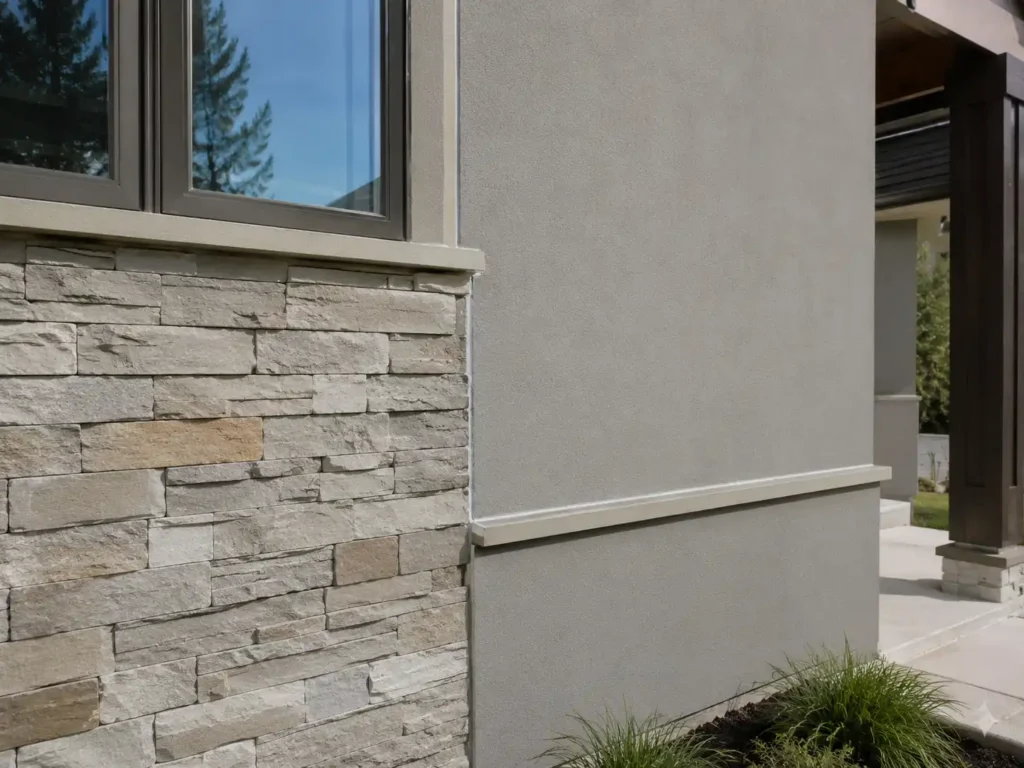
The most common leak on a mixed-cladding house is the seam where stone meets another material, usually stucco or fiber cement.
On most jobs that joint has two contractors on either side of it. When it leaks, each one says it’s the other’s detail. Nobody fixes it until there’s damage inside.
We install stone, thin brick systems, and hard coat cement stucco, so on our jobs that seam belongs to one company. We also handle the broader masonry contractor scope on the same house.
If your stone is more than five years old, there are three things worth checking. Is the bottom of the stone buried in mulch or sitting directly on the patio? Is there a kickout flashing where the roof meets the wall? Is there staining or soft trim anywhere below the veneer?
Any of those is worth a moisture intrusion inspection before it becomes a framing repair. We do the inspection and the repair, so you get one answer instead of a referral.
We work with natural and manufactured veneer on homes and commercial buildings, and our owner has 25+ years in stone, stucco, and masonry. You can see our finished work in the gallery.
We cover Bergen, Essex, Passaic, Morris, Union, and Hudson counties within about 25 to 50 miles of Hackensack. Estimates are free for property owners and commercial general contractors. Call (201) 750-3590 Monday through Friday, 9am to 5pm, or request an estimate online. New Jersey HIC registration 13VH11592500.
ASTM C1780 guidance calls for veneer to stop at least 4 inches above grade and at least 2 inches above hard surfaces like driveways, patios, and steps. Those gaps are not cosmetic. They are how water gets out from behind the stone.
Almost always a missing drainage detail. If there is no weep screed at the bottom, no drainage plane behind the stone, or no kickout flashing at the roof line, water that gets behind the veneer has nowhere to go. It sits against the sheathing instead.
Yes, and this is where most walls leak. The joint between two different claddings has to be detailed and sealed properly. Because we install both stone and stucco, that joint belongs to one contractor instead of two trades pointing at each other.
Yes. We work with both natural and manufactured veneer. Manufactured stone absorbs considerably more water than natural stone, which makes the drainage detail behind it even more important.
Yes. We work within roughly 25 to 50 miles of our Hackensack shop, covering Bergen, Essex, Passaic, Morris, Union, and Hudson counties, plus New York City, Westchester, Rockland, Orange, and Putnam counties.
Estimates are free for property owners and commercial general contractors. Call (201) 750-3590 Monday through Friday, 9am to 5pm. Our New Jersey HIC registration is 13VH11592500.